Christmas
William TellChristmas is proposed as the moment when customary obedience can be turned into an opportunity for revolt. The plan depends on an annual visit by serfs bearing gifts to the governor: while a small, selected party enters the castle under that familiar pretext, armed supporters wait outside to help take the gate. Christmas is therefore not simply a festive date in the play’s political calendar. It is a proposed cover for a carefully timed seizure of power, though the evidence presents the operation as a plan rather than confirming that it takes place on that day.
Christmas as a Proposed Date
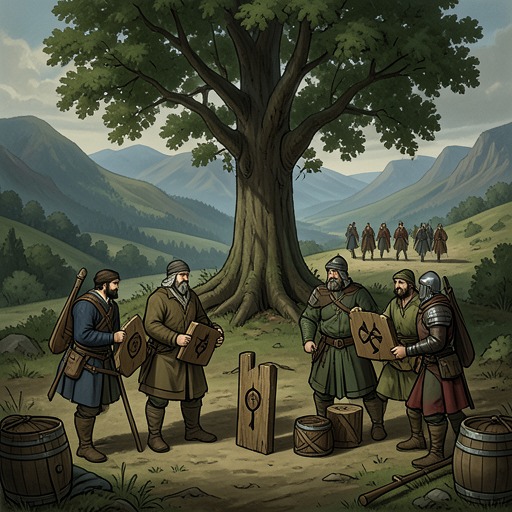
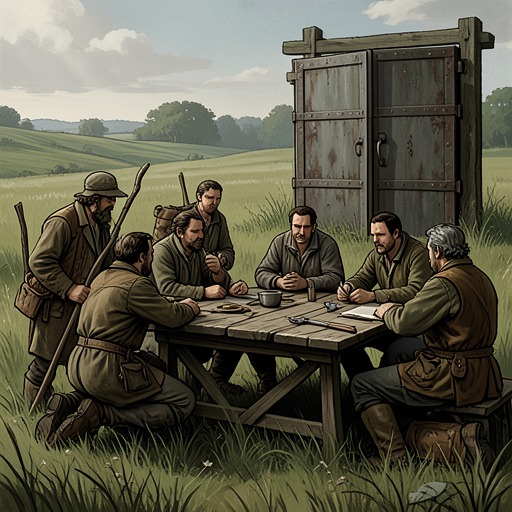
The suggestion comes during a debate over whether the conspirators should act immediately or wait. One speaker objects that haste disturbs the peace and reminds the gathering that they stand for a common cause; in response, the proposal is to delay until Christmas. The argument for waiting is practical: the customary gathering of serfs at the castle to deliver their annual gifts would provide a plausible reason for selected men to pass inside. A recurring social obligation, already familiar to the governor and his household, could conceal an extraordinary political purpose.
The date thus gives the conspiracy a structure. Rather than rely on an open assault, the proposed action is attached to a predictable point in the year, when the castle receives visitors in a customary capacity. The plan’s force lies in the contrast between the apparent meaning of the occasion and what the conspirators intend to do there. The gifts signify an established relationship between ruler and dependants; the proposed entry would use that relationship to get men within the walls and make the ruler’s stronghold vulnerable from inside.
The wording remains conditional. The conspirator asks what would happen if they delayed until Christmas, and then outlines the opportunity that delay might create. This establishes a proposed date and method, not proof that the attack is ultimately carried out according to schedule. The distinction matters: Christmas marks the planning of an operation, while the play’s other references to an approaching year give the larger revolt a broader deadline.
The Annual Custom as Cover
The suggested operation is divided between men inside and outside the castle. Some ten or twelve selected men would assemble unobserved within its walls, carrying steel pike heads concealed on their persons. Because weapons are not admitted into the fort, the pike heads could be mounted quickly on staves after entry. The details answer a specific obstacle: the conspirators cannot simply bring assembled weapons through the gate, so they propose bringing in components that can be made ready once they are inside.
The remaining supporters would wait in the neighboring wood. At a trumpet signal, they would sally forth after their comrades had secured the gate. The design depends on coordination between concealment and force: the gift-bearing party is to create an opening inside the walls, while the larger body waits beyond them, ready to exploit it. The proposed sequence is clear—enter without notice, assemble the weapons, seize the gate, and let the supporters outside advance. Its stated object is to make the castle theirs with ease, although that confidence belongs to the proposal, not to an account of a completed assault.
Melchthal responds by undertaking to scale Rossberg Castle, giving the discussion a specific stronghold and an additional route of attack. His intervention suggests that the conspirators are considering separate operations against fortified positions rather than describing only an abstract wish to resist. The Christmas stratagem is one concrete answer to the problem of access: custom opens a door that arms alone cannot force. The mention of Rossberg Castle adds a particular objective, but does not establish that every detail of the gift-day plan applies to that castle.
Christmas and the Imminent Blow
A later pledge places the struggle within a tighter temporal horizon: before another year begins its circuit, the blow is to fall, and the speaker anticipates that the dead will rest in a free land. This language gives the planned revolt the urgency of a deadline. It resonates with the suggestion to wait until Christmas, but the pledge does not itself name Christmas or specify that the attack must occur on that date. The play therefore distinguishes between a particular tactical proposal and the larger promise of action before the turn of the year.
That distinction prevents the calendar from becoming a simple countdown with a fully documented endpoint. Christmas is the proposed occasion for exploiting the governor’s annual reception of gifts; the pledge before the new year expresses the expected arrival of a decisive change. Together, the references make time political: the conspirators must decide when patience becomes dangerous delay, and when a familiar custom can be made to serve a new purpose. The evidence supports an expectation of imminent action, but not a claim that the Christmas plan succeeds exactly as outlined.
Custom, Ceremony, and Reversal
The Christmas scheme belongs to a play in which public customs and prescribed gestures repeatedly display power. Earlier, a crier announces that a cap will be placed on a pole in Altdorf’s marketplace, and the men of Uri are ordered to take notice of it. That imposed public emblem makes obedience visible. The gift custom works differently: it is not described as a command to salute, but as a regular occasion on which serfs come to the governor. The conspirators see how the predictable performance of subordination might conceal resistance.
The play later returns to the cap in a changed political setting. Girls bring it in on a pole before a stage filled with people, and Furst argues that it should be preserved because what had served despots can become a lasting symbol of freedom. The altered meaning of the object throws the Christmas proposal into relief: political change can repurpose familiar forms, whether a public emblem or an annual visit. The plot does not equate these acts, but it gives both customs a capacity to carry meanings different from those their authorities intended.
Other collective gestures in the drama sharpen this contrast. Rosselmann calls for a ring to be formed and swords of power planted in the ground; later, those present involuntarily remove their caps and contemplate the breaking day in silence. These moments place shared commitment within visible ceremony. Against that background, Christmas is strikingly practical: its significance lies not in a new rite but in the conspirators’ reading of an existing one. Its narrative role is to show how the calendar and customary behavior can furnish the conditions for revolt, while leaving the outcome of this particular proposed operation unconfirmed.